Review: The Savage Detectives
This is the second book of Robert Bolaño’s I’ve read, and he’s definitely grown on me. The Savage Detectives is a book following poets in Mexico that are part of a movement called ‘the Visceral Realist movement’, in Spanish known as infrarrealismos. Like Bolaño’s 2666, the book has an unusual structure, starting with a personal diary of Juan Garcia, a poet in Mexico; then a middle section following dated interviews across several decades concerning two other poets, Arturo Belano and Ulises Lima, and then finally ending with a continuation of Juan’s diary. The structure, its length and its seeming meandering is an intentional style and choice to help exhibit the elusiveness of the two poets at the heart of the book, Arturo Belano and Ulises Lima. As I read this, I truly felt the essence of this book was about the performative nature of youth and their movements, in this case one about the poets and not about the poetry itself.
There’s a lot of topics and themes that emerge in the book, but what I really got obsessed over were the two enigmatic and nomadic poets featured quite heavily in the book: Arturo Belano and Ulises Lima. The poets sort of hang out at bars and cafes to recruit other poets to their Visceral Poets movement to challenge Octavio Paz and his camp of poets and literary establishment. You may know Octavio Paz as the real life Mexican author and poet famous for his work The Labyrinth of Solitude. Where things get structurally confusing but also interesting is Part 2 of the book, which dominates in length, us readers get glimpses of both the poets in interviews of people who cross paths with them during different eras across decades and places throughout the globe.
Part 2 took some getting used to, I started to see it as nomadic and sporadic as the two poets’ lives. Eventually that turned into part of the meaning of the middle section’s structure, each interview painting the picture of the poets at different angles, lending itself to the characteristics of both Arturo and Ulises. Both poets are so memorable to the observer and we get really good details about them, but they themselves are never interviewed, so they seem enigmatic to us the reader because all the interviews paint them that way, as passing forces in other people’s lives. At the same time, the interviews jump from location to location, year to year, forwards and backwards, and this lack of a linear structure also lends to both of their elusiveness.
Across the interviews, the two of them end up telling completely different stories about how a person disappears. Ulises drifts and thins out, leaving notebooks behind without much concern, him being more concerned with the act of writing than what happens to the pages after. Arturo confronts things head on, picking fights, throwing himself into danger. Ultimately, I started to enjoy these vignettes of the poets. The little peekholes into a fragment of their life through another’s lens was interesting. They also seem like the closest of people, but polar opposites. Where Arturo is sharp and combative, even engaging in a duel with a literary critic, Ulises is eccentric and detached, reading books in the shower.
I rushed into the review with Part 2, but in Part 1 of the book our entrance into the Visceral Realist movement is Juan García Madero. I felt like he was someone who entered the picture without realizing what he was getting into, and got swallowed up in things. Juan acts as our guide into the movement, the poets, their benefactors, and much more. He’s basically the newbie, and he’s also the most innocent in all the givings, he doesn’t drive anything himself, but gets wrapped up in it while pursuing his joining of the movement. I did find him and his journals unrealistic though, he claims amazing love and sexual conquests among many other things, it feels embellished and unreliable.
One thing I thought was interesting was that the focus was less on the poetry and more on the poets and their lives, their desire to live some specific “style,” whether it was on one end like Lima or the other like Belano. It was less about the poetry, and more about the youthful desire to create a change and drive a movement, living as romantics in every sense. The only poems that stayed with me are the ones with the pictures in three poem lines, I stopped reading to see if I could make some meaning from them, I never thought of writing a poem in purely pictures but I thought it was interesting here. I also thought it was funny how Juan knew nearly every structural definition of a poem, but Arturo and Ulises knew nothing, the newbie was coming in with a ton of real knowledge of poetry but the founders knew nothing of that. I think that fact showed a few things, like how Juan was perhaps really seeking to be a poet and came prepared thinking he needed to be knowledgeable in poetry, and then that perhaps all that knowledge is actually not that useful and might confine you from being an avant-garde poet because you’re relying on another form or structure. It also lends itself to Belano and Lima’s character even further, where they never bothered with the academic aspect of poetry at all.
Sprinkled throughout the book we learn about Cesárea Tinajero, although at first you might pass her off, eventually you start to connect the dots that Arturo and Ulises discovered her writings and elevated her to a sort of sainthood and matriarch of the Visceral Realist movement. I found it interesting how the story took a turn into a quest looking for her, I won’t get into where that goes, but it definitely felt like a mirror of the quest to find Hans Reiter in 2666, another elusive and hidden writer, only to find out what we expect as a reader turns out to be a very different identity behind the writing. You get to see Cesárea’s poems in the book which I thought were fascinating. For instance, the poem Sión, pictured below, is something that I was not expecting.
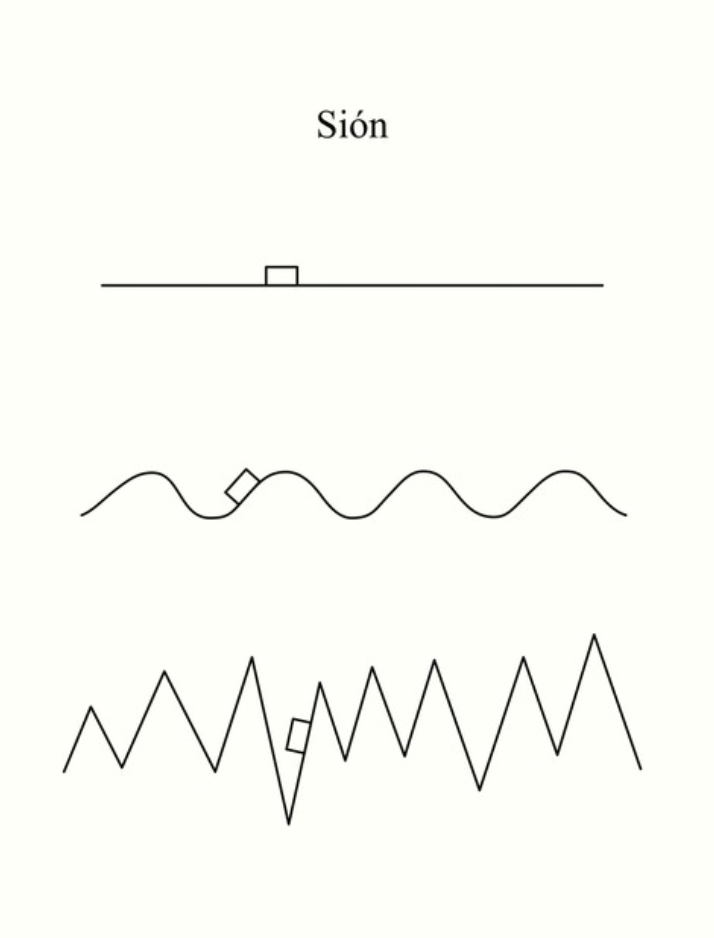
At some point the poets analyze her poetry, and as a reader you get the chance to as well. First, I’ve never seen a poem where the lines are a mixture of shapes. Then I gave it some thought, perhaps its a poem about how life advances to be more complex. Or maybe its the progression of calmness to disturbance. Once again, it could also just be another nod to minimizing actual poetry in words or the formal format or structure as we know it. Finally, my last thought was it was interesting to see it as progression is meant to be experienced, you cannot study poetry and become a poet, you need to get out of the calm zone. You can place Juan Garcia on line one, and the progression towards entering the world of Ulises Lima and Arturo Belano advancing towards where they are on Line 3.
I gave this four stars, maybe because it’s long and not that accessible. I wouldn’t go and just recommend this to anyone, I still believe that 2666 and now The Savage Detectives require a brave and patient reader. However, I do think it’s a great book and something worth reading for the challenge, and for taking on a novel that isn’t on the beaten path. If you like any other of Bolaño’s work, then its likely a no brainer to pick up and read. For such large novels that are without the most straightforward structure, plot, style or characters, they are rather highly memorable because of those aspects being used to evoke a certain sense and meaning. Something about Bolaño’s novels stick with you, and it’s because he demands it does in his writing.